Before the existence of digital databases, health registries, and searchable pedigrees, much of the documented history of the Staffordshire Bull Terrier was preserved through written observations rather than structured data. Among the most consistent of these historical records are judges' critiques and reports. While judges were not responsible for directing the breed’s long-term development, their written material now serves as an important historical source, provided it is read with care and within proper context.
Historically, judges occupied a position that allowed them to see a wide selection of dogs from different breeders, regions, and bloodlines. Their assessments were made at a specific moment in time, under specific conditions, and according to the contemporary understanding of the breed standard. What they recorded was what stood before them on the day of judging. They did not have access to complete pedigrees, long-term health outcomes, or the broader breeding strategies behind the dogs they evaluated. Their role was observational, not strategic, and this distinction is fundamental when interpreting their contribution to breed history.
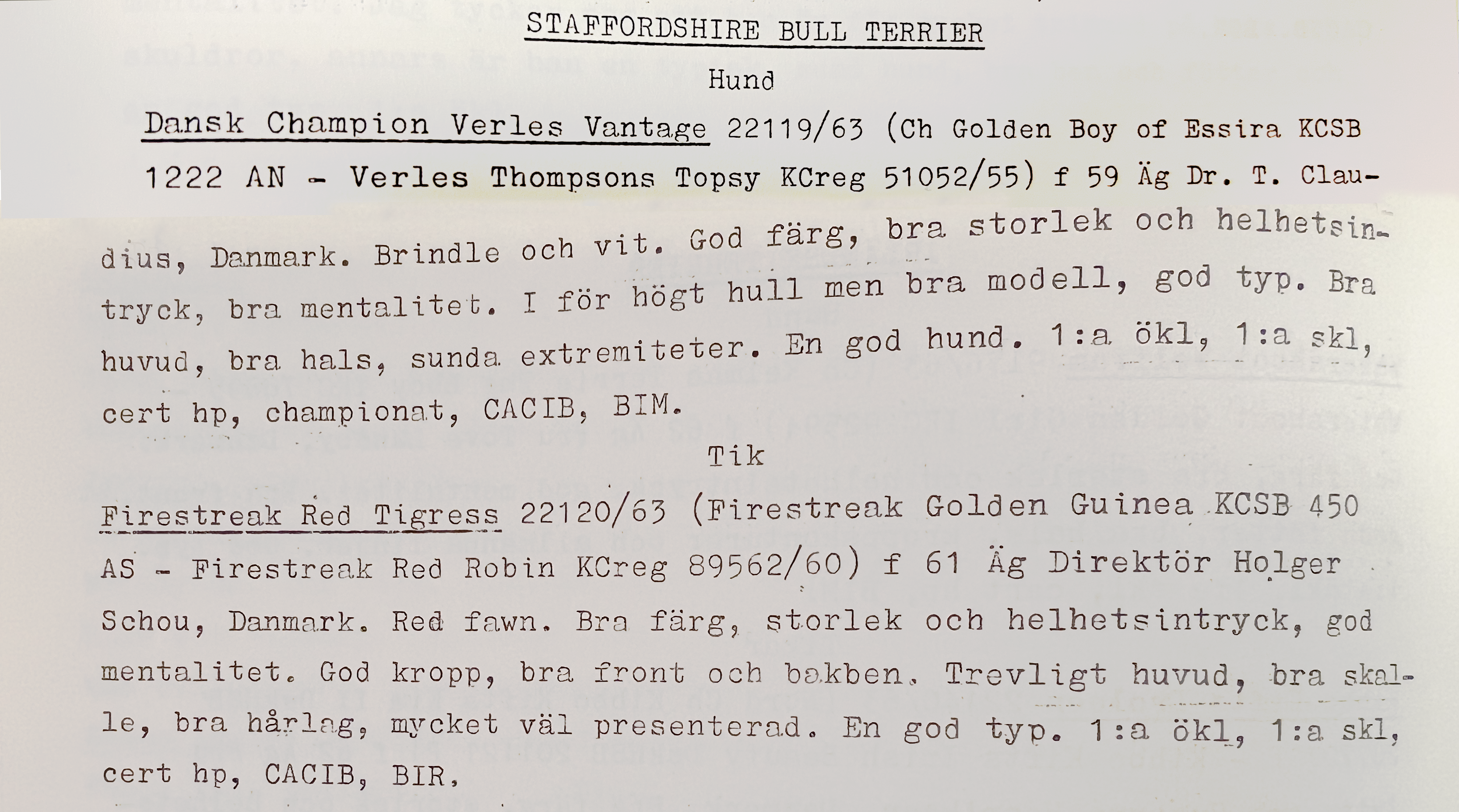
The written critiques left by judges primarily describe visible traits. Structure, balance, movement, head type, and overall conformity to the standard were the focus of most evaluations. These descriptions provide valuable insight into how the Staffordshire Bull Terrier was presented and perceived during different periods. At the same time, the limitations of such material must be acknowledged. Historical critiques rarely, if ever, address health, longevity, fertility, or genetic sustainability. They reflect phenotype rather than long-term breeding value, and they document appearance rather than consequence.
A common misunderstanding in retrospective discussions is the tendency to attribute a guiding role to judges in the breed’s development. Judging trends may reflect the prevailing preferences of a particular era, but they do not, in themselves, control the direction of the breed. Development ultimately occurs through the cumulative breeding choices made by breeders, shaped by population size, available genetic material, and practical constraints. That said, judges do influence the climate in which breeding decisions are made. Dogs placed at the top of major shows are often perceived as representing a form of approval or endorsement. As a result, their type, construction, or expression may gain popularity and be more widely used in breeding programmes. In this way, judges can contribute indirectly to shifts in emphasis within a breed.
However, this influence remains secondary. Judges evaluate what breeders present to them; they do not create the gene pool from which future generations are bred. Historical analysis therefore calls for caution in overstating the role of any single function or individual in shaping a breed’s long-term development.
Another challenge lies in how historical judge material is interpreted today. Reading older critiques through a modern lens can lead to overinterpretation, selective citation, or the projection of contemporary ideals onto past evaluations. Without an understanding of the context in which these critiques were written, including the size of the population, the level of variation present, and the norms of the time, conclusions drawn from them may become misleading. Historical sources based on observation require restraint, not certainty.
When used responsibly, judges' records remain a valuable component of breed history. They can help illustrate variation in type over time, provide context for historical pedigrees, and contribute to a broader understanding of how the breed was viewed during different periods. Their value lies in being read alongside other sources, not in isolation. They complement pedigree data and historical accounts but cannot replace them.
Judges left behind observations, not instructions. Their critiques document moments in time rather than long-term intent, and their importance lies in careful interpretation rather than definitive conclusions. Understanding the history of the Staffordshire Bull Terrier depends not on elevating individual records beyond their scope, but on recognising both their contribution and their limitations.